


E-commerce KPI

E-commerce KPI training

Qualiopi-certified training organization. Our training courses are offered to companies, either face-to-face or remotely, in French or English , and are Opco eligible.

This course aims to enable e-commerce, marketing and data teams to structure a clear and coherent reading of e-commerce performance, based on essential KPIs covering the entire customer journey. It provides a common, tool-independent analysis framework to better understand growth drivers, identify friction points and drive business decisions.

Objectives

– Structuring e-commerce performance analysis
– Analyze audiences and traffic quality
– Manage product acquisition and discovery
– Optimize conversion, monetization and loyalty

Target audience

E-commerce teams (acquisition, merchandising, UX…). Marketing teams (CRM, advertising, etc.). Data and analytics teams (data analysts, business analysts).

Prerequisites

– Computer skills
– Basic knowledge of e-commerce and digital marketing
– Fundamentals of digital performance
– No specific analytics tools required, independent of solutions (GA4, Piano, Adobe…)

Benefits

At the end of the course, participants and their companies benefit from :
– a clear, shared vision of e-commerce performance,
– better prioritized, faster decisions,
– a structured analysis approach across the entire customer journey,
– a reduction in misinterpretations of data,
– better alignment between business and data teams,
– profitability- and value-creation-oriented management.

Level

Beginners to advanced.

Duration

From 2 h to 12 h depending on the modules chosen.

Practical information

In-company training delivered by an instructor specialized in digital analytics, on site or remotely.
See our practical details >

Module 1: E-commerce KPI – Fundamentals

Level: Beginner | Duration: 2 h

The essentials for analyzing e-commerce performance

Objectives:
1. Learn to work with key e-commerce KPIs and KPI trees
2. Understand the e-commerce market equation and how its components work together
3. Familiarize yourself with the e-commerce analysis framework

Module 2: E-commerce KPI – Audience

Level: Beginner | Duration: 2 h

Understand and analyze e-commerce audiences while mastering data quality issues

Objectives:
1. Understand the differences between customer, user and session in analytics
2. Learn how to analyze an audience by device, location, demographics and other dimensions
3. Identify the factors that influence data collection (adblockers, confidentiality, consent, etc.).

Module 3: E-commerce KPIs – Acquisition

Level: Beginner | Duration: 2 h

Analyze and optimize acquisition channel performance to improve traffic quality

Objectives:
1. Identify the different acquisition channels (online vs. offline, paid vs. organic)
2. Understand basic acquisition frameworks (TOFU, MOFU, BOFU)
3. Learn how to analyze channel and campaign performance

Module 4: E-commerce KPI – Merchandising

Level: Beginner | Duration: 2 h

Understand and analyze product descent by studying navigation, search and discovery paths

Objectives:
1. Identify content categorization and navigation patterns
2. Understand product discovery paths
3. Learn to analyze product navigation and search behavior.

Module 5: E-commerce KPI – Checkout

Level: Beginner | Duration: 2 h

Analyze the order tunnel to identify pathways, measure abandonment and detect friction points

Objectives:
1. Identify the different possible paths in an order tunnel
2. Understand how different abandonment rates are calculated
3. Learn to analyze funnels

Module 6: E-commerce KPI – Monetization & Loyalty

Level: Beginner | Duration: 2 h

Analyze monetization and loyalty to drive e-commerce revenues and profitability

Objectives:
1. Identify the different types of monetization and the differences between retention and acquisition
2. Understand how to calculate key monetization and retention indicators
3. Learn how to analyze the profitability of an e-commerce site.

Our teaching methods

Our 2-hour modules are designed to maximize participants’ concentration and commitment. Using real-life case studies and your own data in complete confidentiality, you’ll easily assimilate the concepts covered. Our approach is pragmatic: we share best practices and concrete avenues of analysis.

Learning assessment

A multiple-choice questionnaire is sent to all participants at the end of each training module. A score of at least 70% is required for validation. A training certificate is sent to each participant for the modules completed, once the training is over.

Accessibility

Our online and face-to-face training courses are accessible to people with disabilities. We identify the constraints linked to the disabled situation (accessibility of premises, equipment, mobility, compatibility with the training course, timetables, pace…) and assess the specific needs to adapt the training courses.
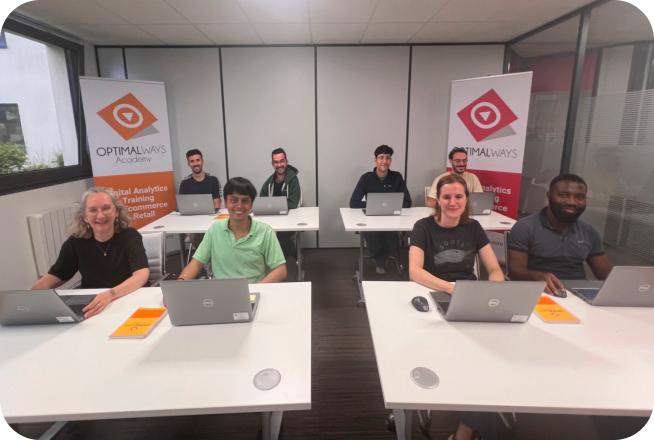

Pourquoi choisir Optimal Ways Academy ?

  • Nos formateurs experts en Digital Analytics permettent à vos équipes de progresser rapidement dans la démarche d’analyse et d’optimisation.
  • Nos modules de 2 heures sont conçus pour maximiser la concentration et l’engagement des participants. Ce format souple facilite la planification des formations pour vos équipes.
  • Nos programmes sont conçus pour répondre parfaitement aux besoins uniques et au niveau de maturité de votre équipe.
  • L’étude de cas réels et l’utilisation de vos propres données en toute confidentialité permet un apprentissage facile des concepts abordés.
  • Nos formations favorisent rapidement et concrètement le développement de nouvelles compétences pour vos équipes.
  • La certification Qualiopi atteste de la qualité et l’efficacité de nos actions de formation continue.

Ils nous font confiance

Depuis la création d’Optimal Ways Academy, des équipes de nombreuses enseignes
 d’envergure nationale et internationale ont pu bénéficier de nos formations.